
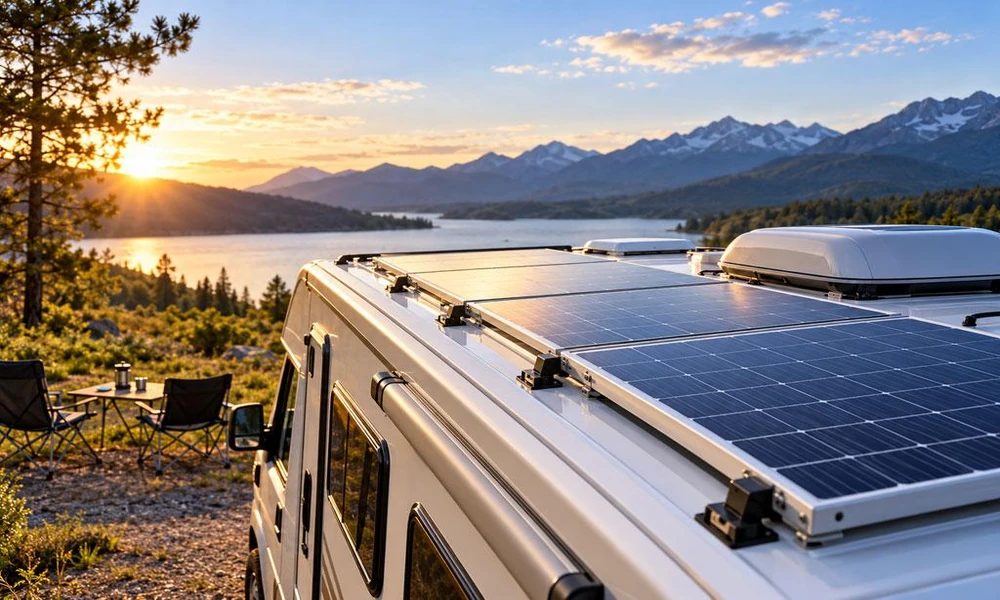
For an RV owner, solar power is closely tied to everyday comfort. Charging devices, running lights, and supporting a leisure battery can make a campsite more convenient. Buyers naturally compare panel wattage, size, and price. The materials sealed inside the panel deserve attention as well, particularly when the vehicle will travel through different climates and spend long periods outdoors.
Recreational vehicles are among the applications identified by stakeholders in a U.S. Department of Energy consultation on vehicle photovoltaics. The consultation also distinguished between electricity used for propulsion and electricity supporting auxiliary loads. For RV buyers, that distinction helps frame realistic expectations: the proposed solar system should be matched to the equipment and battery it will actually serve
Start with that energy requirement. List the devices used during a typical stop, their operating hours, and the battery capacity available. Then consider where the vehicle is parked. A roof shaded by trees may offer a comfortable campsite while limiting generation. Encapsulation quality belongs within this wider system decision, alongside the charge controller, wiring, battery, and available roof area.
Inside a laminated solar panel, encapsulation films surround the cells and bond them to adjacent protective layers. These films are distinct from the sealant used around a roof penetration or the adhesive beneath a mounted panel. Asking suppliers about each material separately helps reveal whether they have considered both the module construction and its installation on the RV.
For a touring vehicle, it is useful to describe the expected travel pattern before comparing materials. A van used for weekend trips in one region may face a different exposure history from a motorhome crossing humid coastal areas and cold mountain routes. Suppliers can use that information to propose a test plan and explain which parts of their existing evidence apply.
EVA encapsulation is one option to discuss. EVA solar films with a focus on adhesion, optical properties, and lamination compatibility. An RV panel manufacturer considering this range should identify the relevant grade and evaluate it with the intended glass or polymer cover and rear protective layer.
POE encapsulation is another candidate when moisture management is a significant design consideration. POE solar film is positioned for photovoltaic applications requiring moisture resistance and electrical insulation. Buyers should ask module manufacturers how a proposed formulation performs within the complete panel, including its edges and cable exits, rather than relying on the polymer name as a quality rating.
This matters because the interfaces remain important even when the bulk material has attractive properties. DuraMAT research has examined changes in encapsulant adhesion after exposure to different combinations of heat and humidity. Its findings support asking for aged adhesion evidence, alongside initial measurements, when comparing proposed constructions. They should not be treated as a ranking of every commercial formulation.
Panel format introduces another set of questions. A rigid panel mounted on brackets and a lightweight panel bonded close to the roof have different installation arrangements. Before choosing either, establish the roof’s load limits, attachment requirements, access for inspection, and replacement procedure. For a curved surface, obtain the manufacturer’s permitted installation geometry instead of assuming the panel can follow any contour.
A useful supplier conversation should connect the warranty to those installation details. Ask what the warranty covers, which mounting methods are accepted, and what records must be retained. Also ask how a failed panel would be removed without damaging the roof. These questions are particularly relevant when the panel is closely bonded to a large exterior surface.
Inspection and maintenance should be planned before purchase. The owner needs access to visible edges, connectors, and mounting points, with clear instructions for cleaning and checking the installation. Any discoloration, lifting, cracking, or unexpected output change should be assessed against the manufacturer’s guidance. A simple maintenance record can also help identify whether a problem developed gradually or followed a specific event.
For procurement teams, the comparison should include documented panel tests, material traceability, installation support, and the supplier’s ability to explain its design choices. A lower initial price may be attractive, but removal, roof repair, and replacement logistics also affect ownership cost. Those costs are easier to discuss when the panel construction and mounting method are transparent.
It is also worth requesting a sample inspection report from the panel supplier. A report that identifies the tested construction, exposure conditions, and measured changes is more useful than an unsupported durability claim. For a buyer comparing several panels, consistent documentation makes differences easier to understand and discuss with the installer.
EVA and POE solar films can form part of that material evaluation for manufacturers developing RV panels. Matching the film to the cover, rear layer, process, and travel environment creates a clearer basis for trials. For the eventual RV owner, that work supports a purchase decision grounded in the whole installation and the way the vehicle will be used.
